
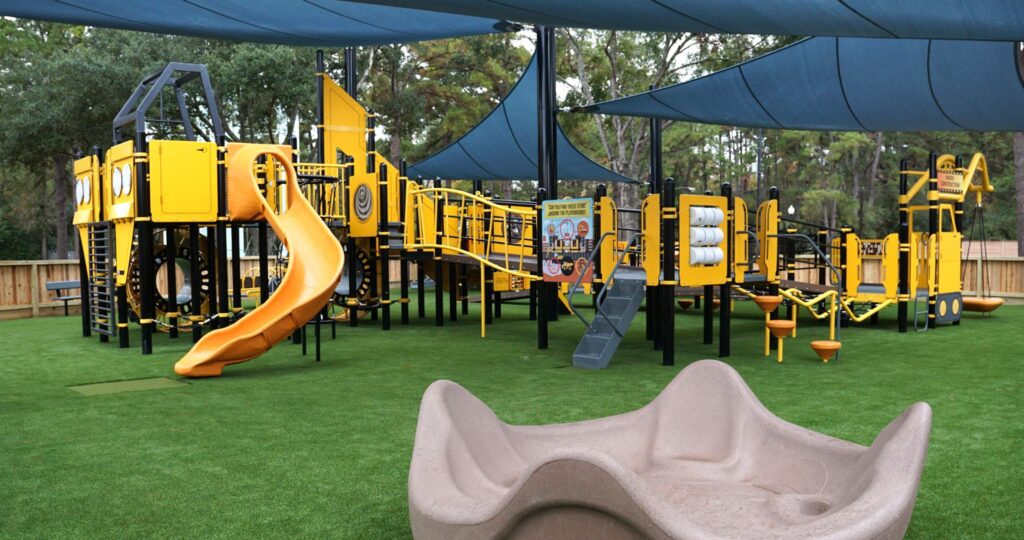
Everyone wants to feel truly included. That is just as true on the playground as it is anywhere else. Families want spaces where children can move through the playground with ease, find play options that spark their interest, and experience the joy of laughter, smiles, and squeals of delight.
ADA compliance matters, but it is a starting point. A playground can meet minimum accessibility standards and still fall short of real inclusion. There is a real difference between meeting the minimum and creating a space where more park visitors can truly participate. ADA standards mainly focus on mobility access, while truly inclusive play goes further by considering sensory, visual, auditory, cognitive, and social needs too.
When ramps are installed in playgrounds but lead to mulch that needs to be navigated, it can be tiring, frustrating, or even impossible to push through. And once a child gets there, what can they actually do? Inclusive play is not just about reaching the playground. It is about being able to join in once you arrive.
Inclusive play extends beyond mobility access to the playground to include sensory, visual, auditory, cognitive, and social experiences, all of which can show up in thoughtful ways:
-
- Quiet areas such as Cozy Domes®, shaded seating areas, and small-group play zones where children can step away, reset, and return when they are ready
- Visual interest through color contrast, clear wayfinding, and thoughtfully designed play elements that help children understand the space and feel invited to explore.
- Tactile experiences such as sensory panels, textured play elements, and Glass Fiber Reinforced Concrete (GFRC) components invite children to touch, explore, and engage with the space in different ways.
- A variety of fine motor, gross motor, and low-mobility play options give children of different abilities more ways to engage in imaginative and social play. Features like the OmniSpin® Spinner and Optigear Panel® support movement, coordination, and hands-on exploration.
- Cooperative play features that help children play side by side and encourage group interaction with peers and siblings, like the We-Go-Round® and We-Go-Swing™.
At Lone Star Recreation, we want to help make inclusive play conversations easier and help communities create playgrounds that are truly inclusive. Playgrounds should be safe for play, built to last, and welcoming to more children and families from the start. Inclusive play is not an extra. It is part of building a better playground for the whole community.